
It's 11.22.11, and I turn 44 today. Seems like there must be some significance to that. A dramatic start to the day supports this theory: I got up early, made an extra large cup of coffee, brought it back to bed with me to enjoy while I read some Raymond Carver stories, and dumped the whole cup all over the bedspread, sheets, and pillows. They're in the wash now. Let's hope that's not an indicator of the entire day's spirit.
There was some bowling on Saturday, and tonight I'm meeting up with a few friends for pool at a local bar. Plus dinner with Amber and lunch with Alison. Should be nice.
I should tell you that Alison has made up her mind that she doesn't want to move back in with me. She's found a new apartment, which she'll be moving into in December. It's a sublet until April. I don't know what will happen after that. We'll be dividing up our finances too, as funds will be tight and we'd like to avoid any poverty-induced conflict.
There are no hard feelings on either side. This is something she probably should have done four years or more ago, in retrospect. I think it'll be a very good growth opportunity for her. And for me, for that matter. We'll be maintaining a close, intimate, platonic relationship with open minds about what it could be in the future.
Lest my neutral tone be misinterpreted as uncaring, though, I'm really sad about this. Hopeful for the future, but really sad in the present.
It's a beautiful sunny day right now, and I don't have much work to do, so maybe I'll go for a walk, get some more coffee. But it's also below zero, and there's frost everywhere. What am I to make of these mixed messages? Just dress appropriately, I guess...
Tuesday, November 22, 2011

Monday, November 21, 2011
Presence
 I just finished Alan Watts's The Wisdom of Insecurity, a book I've been meaning to read for years. Boy, did I need it, and boy, is it great. Full of sage advice about acceptance and exploration of what is, now, as the only meaningful way of life. It was published in 1951, and it reads like a prophecy of exactly what would be wrong with the culture 60 years later. Here are some of my favourite gems:
"[O]ur age is one of frustration, anxiety, agitation, and addiction to 'dope.' Somehow we must grab what we can, and drown out the realization that the whole thing is futile and meaningless. This 'dope' we call our high standard of living, a violent and complex stimulation of the senses, which makes them progressively less sensitive and thus in need of yet more violent stimulation. We crave distraction — a panorama of sights, sounds, thrills, and titillations into which as much as possible must be crowded in the shortest possible time.
"To keep up this 'standard' most of us are willing to put up with lives that consist largely in doing jobs that are a bore, earning the means to seek relief from the tedium by intervals of hectic and expensive pleasure. These intervals are supposed to be the real living, the real purpose served by the necessary evil of work. Or we imagine that the justification of such work is the rearing of a family to go on doing the same kind of thing, in order to rear another family... and so ad infinitum." [pp. 21–22]
"The common error of ordinary religious practice is to mistake the symbol for the reality, to look at the finger pointing the way and then to suck it for comfort rather than follow it. Religious ideas are like words — of little use, and often misleading, unless you know the concrete realities to which they refer. The word 'water' is a useful means of communication amongst those who know water. The same is true of the word and the idea called 'God.'" [p. 23]
"The discovery of this reality is hindered rather than helped by belief, whether one believes in God or believes in atheism. We must here make a clear distinction between belief and faith, because, in general practice, belief has come to mean a state of mind which is almost the opposite of faith. Belief, as I use the word here, is the insistence that the truth is what one would 'lief' or wish it to be. The believer will open his mind to the truth on condition that it fits in with his preconceived ideas and wishes. Faith, on the other hand, is an unreserved opening of the mind to the truth, whatever it may turn out to be. Faith has no preconceptions; it is a plunge into the unknown. Belief clings, but faith lets go. In this sense of the word, faith is the essential virtue of science, and likewise of any religion that is not self-deception." [p. 24]
"Because consciousness must involve both pleasure and pain, to strive for pleasure to the exclusion of pain is, in effect, to strive for the loss of consciousness. Because such a loss is in principle the same as death, this means that the more we struggle for life (as pleasure), the more we are actually killing what we love." [p. 32]
"[T]he future is quite meaningless and unimportant unless, sooner or later, it is going to become the present. Thus to plan for a future which is not going to become present is hardly more absurd than to plan for a future which, when it comes to me, will find me 'absent,' looking fixedly over its shoulder instead of into its face." [p. 35]
"If I want to be secure, that is, protected from the flux of life, I am wanting to be separate from life. Yet it is this very sense of separateness which makes me feel insecure. To be secure means to isolate and fortify the 'I,' but it is just the feeling of being an isolated 'I' which makes me feel lonely and afraid. In other words, the more security I can get, the more I shall want.
"To put it still more plainly; the desire for security and the feeling of insecurity are the same thing. To hold your breath is to lose your breath. A society based on the quest for security is nothing but a breath-retention contest in which everyone is as taut as a drum and as purple as a beet." [p. 78]
"To understand that there is no security is far more than to agree with the theory that all things change, more even than to observe the transitoriness of life. The notion of security is based on the feeling that there is something within us which is permanent, something which endures through all the days and changes of life. We are struggling to make sure of the permanence, continuity, and safety of this enduring core, this center and soul of our being which we call 'I." For this we think to be the real man — the thinker of our thoughts, the feeler of our feelings, and the knower of our knowledge. We do not actually understand that there is no security until we realize that this 'I' does not exist." [pp. 80–81]
And, if you still have any room left for present moment appreciation after all that, here's some recently composed haiku:
Rain-soaked maple leaves
Tumble freely in the wind
And stick to the road.
The smell of wood smoke
On a cold November night
Warms even the stars.
Huddled on the shore,
We look out at the island.
Sunset's early now.
Wednesday, November 16, 2011
Foreigner Reimagined
I just finished recording this song today for a friend of mine who's making a compilation of 80's pop covers for his wife as a Christmas present. I'm quite sure she doesn't read this blog, but maybe don't mention anything about it to anyone, just in case.
Monday, November 14, 2011
More Touchstones of My Youth Revisited
Has anyone ever read Lila, the sequel to Robert Pirsig's Zen and the Art of Motorcycle Maintenance that came out 17 years later? I picked it up recently at a used book sale and finished it on the weekend. ZAMM blew my mind as a teenager, but when I read it again as an adult I found an awful lot of flaws in Pirsig's sloppy logic. So I guess I kind of avoided this one for a couple of decades. But it was cheap, and there wasn't much else of interest at the sale... It turned out to be way more interesting than I'd expected. I'd like to hear what others thought of it.
As in ZAMM, the fictional travel story that serves as a framework for the novel is boring as hell, but the philosophical musings it weakly supports are imaginative and intuitively compelling. He talks about a lot of the themes that I'm always going on about — integrating spiritual, political, and religious understandings of the world; keeping seemingly contradictory discourses on different levels that shouldn't be mixed; expanding the concept of evolution to include not just biology, but also cultural and even individual consciousness — but he comes at it in a slightly different way. It's not at all rigorous, though, and I'm worried his ideas could be used in defense of completely opposite beliefs.
Still... extremely interesting. Oh yeah, there's even some Foucauldian stuff in there, for the continental fans among us, about cultural repression through definitions of madness, and the folly of "objectivity" as a scientific ideal.
My other source of entertainment lately has been the entire first season of The Bionic Woman, which I picked up when someone else finally returned it to the video store. I really liked that show as a kid, much more than The Six Million Dollar Man, and haven't seen it since. Probably didn't need a whole season's worth of episodes, but so far they've been weirdly enjoyable. But check out the opening credits — is this not the weirdest theme music you've ever heard? What a mess!
As in ZAMM, the fictional travel story that serves as a framework for the novel is boring as hell, but the philosophical musings it weakly supports are imaginative and intuitively compelling. He talks about a lot of the themes that I'm always going on about — integrating spiritual, political, and religious understandings of the world; keeping seemingly contradictory discourses on different levels that shouldn't be mixed; expanding the concept of evolution to include not just biology, but also cultural and even individual consciousness — but he comes at it in a slightly different way. It's not at all rigorous, though, and I'm worried his ideas could be used in defense of completely opposite beliefs.
Still... extremely interesting. Oh yeah, there's even some Foucauldian stuff in there, for the continental fans among us, about cultural repression through definitions of madness, and the folly of "objectivity" as a scientific ideal.
My other source of entertainment lately has been the entire first season of The Bionic Woman, which I picked up when someone else finally returned it to the video store. I really liked that show as a kid, much more than The Six Million Dollar Man, and haven't seen it since. Probably didn't need a whole season's worth of episodes, but so far they've been weirdly enjoyable. But check out the opening credits — is this not the weirdest theme music you've ever heard? What a mess!
Sunday, November 06, 2011
Speaking of Retro...
 Remember in the early 80's when prom-rock band Journey had its own video game? It was pretty cool, right? Each of the five band members was the protagonist of his own minigame through which you'd try to negotiate his avatar — a black-and-white image of his face crudely pasted onto a pixelated body — while sub-primitive electronic versions of Journey's hits played in the background. If you completed all five levels, the band would play a live concert of actual, recorded Journey music (there was a cassette player inside the machine for this part). Pretty awesome.
I always wondered, though, why, of all popular bands, Journey should be the only one to star in a video game. Why not, for instance, Van Halen, who were at least as popular and arguably cooler, especially to the adolescent males who would have been pumping the hypothetical quarters?
Well now, finally, VH do have their own arcade game. Or at least, David Lee Roth does. Eddie and the band (represented by its logo), in an interesting twist, are actually the interstellar antagonists. The game also bears more than a passing resemblance to Asteroids. But who doesn't love Asteroids, am I right? Give it a try. And watch for surprise appearances by Sammy Hagar.
Wednesday, November 02, 2011
Are we there yet?
Lately I've been reading Simon Reynolds's latest book of rock commentary, Retromania: Pop Culture's Addiction to Its Own Past. Its thesis is that we have become so caught up in a kind of nostalgia for the very recent past that we've almost stopped innovating entirely, concerning ourselves instead with reusing, recycling, and remixing "the good old days" of popular culture. Sometimes the revisiting is ironic, sometimes reverent, but his worry is that, regardless, we may soon run out of raw material to rehash, as no one is making anything that looks toward the future anymore.
I don't necessarily buy all of his arguments, and in fact the author himself could be accused of the very nostalgia he denounces, painting the beloved post-punk of his youth as pop music's last attempt at creating something truly new. But he does make some very interesting historical connections, as well as tell some great stories. Plus, I got to find out about this incredible video from the chapter "Total Recall: Music and Memory in the Time of YouTube."
And here's another heartbreaker from the same guy — Daniel Lopatin aka KGB Man aka Sunsetcorp aka Oneohtrix Point Never — this one unfortunately unembeddable.
If that book hasn't been enough to get me all worked up, I've also been reading The Guardian Weekly for a few weeks now, in an attempt to reduce my criminal ignorance of world events. It wasn't a conscious decision, but I think ever since 9/11 I have paid absolutely no attention to the news whatsoever. I guess even before that, it seemed to me a distraction from one's own life — something to talk about with your coworkers, get angry about, and eventually become embittered by, as it's all terrible and there's ultimately nothing you can do about 99% of it.
But lately that point of view has started to seem overly self-centred to me, and I've felt guilty that I haven't been fulfilling my duties as a witness to the time I live in. So I subscribed to The Guardian. I'm not sure it was such a good idea, though. This news stuff is REALLY upsetting! How long have things been this bad? Do people really read this stuff every day? It makes me feel awful about my species and at the same time completely paralysed, like most of the people in the world are going around with points of view that I think are just terrible, and whatever I do with my life is an insulting joke in the context of the enormous atrocities they're generating.
I do enjoy the "Comment & Debate" section, though, especially some of the analyses of the impending worldwide economic collapse. But even that enjoyment is just the consolation of an ego-stroking told-you-so in the face of my culture's demise. Still, there is definitely some entertainment to be had from these "think pieces." Here are a few of my faves from the past month.


I don't necessarily buy all of his arguments, and in fact the author himself could be accused of the very nostalgia he denounces, painting the beloved post-punk of his youth as pop music's last attempt at creating something truly new. But he does make some very interesting historical connections, as well as tell some great stories. Plus, I got to find out about this incredible video from the chapter "Total Recall: Music and Memory in the Time of YouTube."
And here's another heartbreaker from the same guy — Daniel Lopatin aka KGB Man aka Sunsetcorp aka Oneohtrix Point Never — this one unfortunately unembeddable.
If that book hasn't been enough to get me all worked up, I've also been reading The Guardian Weekly for a few weeks now, in an attempt to reduce my criminal ignorance of world events. It wasn't a conscious decision, but I think ever since 9/11 I have paid absolutely no attention to the news whatsoever. I guess even before that, it seemed to me a distraction from one's own life — something to talk about with your coworkers, get angry about, and eventually become embittered by, as it's all terrible and there's ultimately nothing you can do about 99% of it.
But lately that point of view has started to seem overly self-centred to me, and I've felt guilty that I haven't been fulfilling my duties as a witness to the time I live in. So I subscribed to The Guardian. I'm not sure it was such a good idea, though. This news stuff is REALLY upsetting! How long have things been this bad? Do people really read this stuff every day? It makes me feel awful about my species and at the same time completely paralysed, like most of the people in the world are going around with points of view that I think are just terrible, and whatever I do with my life is an insulting joke in the context of the enormous atrocities they're generating.
I do enjoy the "Comment & Debate" section, though, especially some of the analyses of the impending worldwide economic collapse. But even that enjoyment is just the consolation of an ego-stroking told-you-so in the face of my culture's demise. Still, there is definitely some entertainment to be had from these "think pieces." Here are a few of my faves from the past month.


Tuesday, November 01, 2011
Before I Chuck It Out...
... thought you should see the jack-o-lantern I carved in record time yesterday. I kept it pretty classic this year — it looked nice with a bunch of tealights in it.
I had a smaller pumpkin too, but I decided to eat that one.
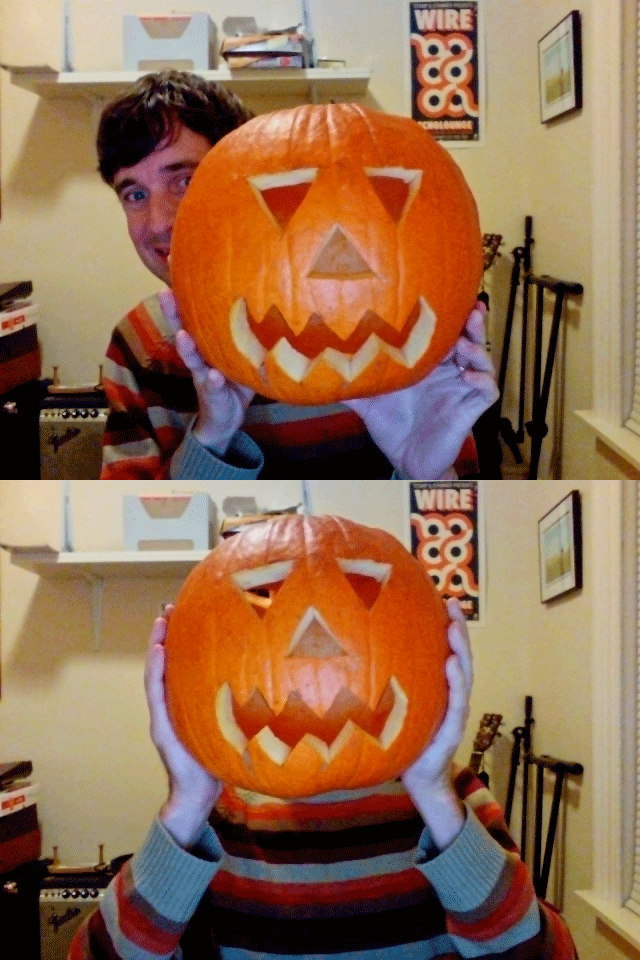
I had a smaller pumpkin too, but I decided to eat that one.
Monday, October 31, 2011
Tuesday, October 25, 2011
Ack II (Seen One)
Well, a hundred bucks, half a day's work missed, and two cab rides later, it turns out to be a fan that needs replacing. Could've been much worse, I guess. But now I have to wait two days for them to get the part in, take the computer back to them, and pay them another $50 to install it. At least I got to have lunch with Ali while I was waiting around downtown, so that was nice...
Ack
Taking my computer downtown to the Apple store this morning because the hard drive's making a horrible whirring, grinding noise, and I'm afraid it's going to conk out any minute. Yikes! Wish me luck.
Monday, October 24, 2011

Thursday, October 20, 2011
Happy Birthday, Dad!
In case you ever find yourself thinking, as I sometimes do, that you miss being gainfully employed by someone else, here's a comic I saved to bring you back to reality.

Have a nice day doing whatever you want!

Have a nice day doing whatever you want!
Monday, October 17, 2011
Ambient Surf
Here's a little music video I made using an iPhone and a microKorg. It's at the beach on the island where our friend Johanna's parents have a cottage. Alison and I were there with her over Thanksgiving weekend. The light on the sand under the water was mesmerizing.
Wednesday, October 05, 2011
Religion! Science! Go to Your Rooms!
So, getting back to the whole "How can we integrate spiritual thinking into a culture whose worldview has become almost 100 percent empirical, and what exactly are those justifiably grouchy atheists missing when they want to chuck the whole enterprise of self-transcendence over the side?" question, about which I never really stop obsessing... I think I may have stumbled onto an important distinction between science, on the one hand, and less rigorously causal ways of looking at the world, like art and religion.
Here it is; see if you think it's workable: the nature of science is to narrow possibilities, so that we can more accurately predict what will happen next or determine why something happened in the past. Art and religion perform the opposite role from this — they're meant to expand the range of possibilities available to the heart and the imagination.
I don't know if someone else has pointed out this difference before, but it strikes me as a potentially very useful partial definition of each field. Because if we can keep this distinction in mind, we might be able to see when one way of thinking is straying too far into what should properly be the realm of another, and thereby prevent things from getting all messed up in terrible ways. For instance, religion notoriously makes claims about the origins of things, which claims end up disagreeing with science. It should stop doing that, because that's not its job. Or at least, it should admit that its origin stories are to be taken as fictional: there only to open our minds to possibilities that are not allowed by science.
Telling us what we should and shouldn't do, at least in concrete terms, is also something it should stop doing. Again, this is a way of narrowing possibility, rather than broadening it. Having us look inside ourselves at our motives, imagine what might be going on in other people's minds, or try to experience everything we perceive in some different way — those kinds of things are all fine and exactly what the point of religion (and partially of art) should be. But rules such as the ten commandments will have to go if we accept this distinction as prescriptively valid.
On the other hand, science can definitely overstep its bounds too. For instance, when people put their faith in the progress of technology as the way for the human species to realize its potential, that's probably not a very good idea. Technology does, granted, open up possibilities that were previously unseen, but it does so only in combination with imagination. If we start allowing technology's evolution to usurp the need for human imagination, as we seem to have been doing for a few decades now, we're in big trouble. Think The Matrix/Terminator scenarios, assuming we don't destroy our own habitat before creating artificial intelligence.
A broader mistake that science can make, and I would accuse Richard Dawkins and his disciples of this one, is to think that it has the answers to all the interesting questions humans can meaningfully ask. To put it negatively, the position is that if your question is not in principle answerable by verifiable, objective observation, then it turns out to be meaningless. It's the kind of smug, positivist attitude that convinces people who have no interest in science that the whole field is bad news. But luckily, it's just not valid.
Science is great at answering questions that demand a narrowing of options: What is the principle cause of global warming? (Twentieth century human culture.) What existed before the Big Bang? (Nothing.) Does God exist as some kind of being or measurable force? (No.)
But there are lots of other kinds of questions that science has nothing useful to say about: How can I better empathize with my neighbour? What is the nature of love? What does existence feel like if time is seen as an illusion? These kinds of questions require answers like, "Observe your own thought process without judgment," "Say this prayer with meaning," or "Listen to this piece of music." And it needs to be OK to only be able to give answers like that — otherwise, we miss out on too big and important an area of possible human experience.
Here it is; see if you think it's workable: the nature of science is to narrow possibilities, so that we can more accurately predict what will happen next or determine why something happened in the past. Art and religion perform the opposite role from this — they're meant to expand the range of possibilities available to the heart and the imagination.
I don't know if someone else has pointed out this difference before, but it strikes me as a potentially very useful partial definition of each field. Because if we can keep this distinction in mind, we might be able to see when one way of thinking is straying too far into what should properly be the realm of another, and thereby prevent things from getting all messed up in terrible ways. For instance, religion notoriously makes claims about the origins of things, which claims end up disagreeing with science. It should stop doing that, because that's not its job. Or at least, it should admit that its origin stories are to be taken as fictional: there only to open our minds to possibilities that are not allowed by science.
Telling us what we should and shouldn't do, at least in concrete terms, is also something it should stop doing. Again, this is a way of narrowing possibility, rather than broadening it. Having us look inside ourselves at our motives, imagine what might be going on in other people's minds, or try to experience everything we perceive in some different way — those kinds of things are all fine and exactly what the point of religion (and partially of art) should be. But rules such as the ten commandments will have to go if we accept this distinction as prescriptively valid.
On the other hand, science can definitely overstep its bounds too. For instance, when people put their faith in the progress of technology as the way for the human species to realize its potential, that's probably not a very good idea. Technology does, granted, open up possibilities that were previously unseen, but it does so only in combination with imagination. If we start allowing technology's evolution to usurp the need for human imagination, as we seem to have been doing for a few decades now, we're in big trouble. Think The Matrix/Terminator scenarios, assuming we don't destroy our own habitat before creating artificial intelligence.
A broader mistake that science can make, and I would accuse Richard Dawkins and his disciples of this one, is to think that it has the answers to all the interesting questions humans can meaningfully ask. To put it negatively, the position is that if your question is not in principle answerable by verifiable, objective observation, then it turns out to be meaningless. It's the kind of smug, positivist attitude that convinces people who have no interest in science that the whole field is bad news. But luckily, it's just not valid.
Science is great at answering questions that demand a narrowing of options: What is the principle cause of global warming? (Twentieth century human culture.) What existed before the Big Bang? (Nothing.) Does God exist as some kind of being or measurable force? (No.)
But there are lots of other kinds of questions that science has nothing useful to say about: How can I better empathize with my neighbour? What is the nature of love? What does existence feel like if time is seen as an illusion? These kinds of questions require answers like, "Observe your own thought process without judgment," "Say this prayer with meaning," or "Listen to this piece of music." And it needs to be OK to only be able to give answers like that — otherwise, we miss out on too big and important an area of possible human experience.
Thursday, September 29, 2011
Mixtape
Recently someone tipped me off to this incredible music blog, Hippies Before Priests. It's nothing but downloadable mixes of obscure and interesting music, each with its own inscrutable title and blurry black & white cover. Each mix is also compiled into one MP3 file (so there's no skipping tracks or shuffling), with all the tracks volume-equalized and cross-faded lovingly into each other. Just like an old mixtape — brilliant!
I've been downloading them like crazy and enjoying them all. Whoever the guy was creating them, he hasn't made one since December of last year, so I think he might be done. I got all inspired and made a mix of my own, though, so here you go. The title is the download link.

Breakfast Cloud
1. Sunday Morning (live) - The Velvet Underground
2. Ouroboros - Oneohtrix Point Never
3. Magooba - You
4. Besvarjelse Rota - Joakim Skogsberg
5. See Through You - The Oscillation
6. Father Cannot Yell - Can
7. Stainless Steel Gamelan - John Cale & Sterling Morrison
8. Cryndod yn Dy Lais - Super Furry Animals
9. Foot and Mouth '68 - Gorky's Zygotic Mynci
10. Momentary Expanse - Tristan Perich
11. Please Wake Me Up - Tom Waits
I've been downloading them like crazy and enjoying them all. Whoever the guy was creating them, he hasn't made one since December of last year, so I think he might be done. I got all inspired and made a mix of my own, though, so here you go. The title is the download link.

Breakfast Cloud
1. Sunday Morning (live) - The Velvet Underground
2. Ouroboros - Oneohtrix Point Never
3. Magooba - You
4. Besvarjelse Rota - Joakim Skogsberg
5. See Through You - The Oscillation
6. Father Cannot Yell - Can
7. Stainless Steel Gamelan - John Cale & Sterling Morrison
8. Cryndod yn Dy Lais - Super Furry Animals
9. Foot and Mouth '68 - Gorky's Zygotic Mynci
10. Momentary Expanse - Tristan Perich
11. Please Wake Me Up - Tom Waits
Friday, September 23, 2011
Evil Crows
These crows are driving me crazy! Why do they bark incessantly at each other all day, right outside my window? I like birds as much as the next guy, but that ugly noise is REALLY distracting. Do they have to keep yelling to each other for no good reason, like a bunch of obnoxious teenagers? I'm sure they're up to no good...


Monday, September 19, 2011
Good Weekend
Went to a party in my neighbours' backyard Friday night and met some really nice people around a small bonfire. Saturday, The Lodge played a show at Gus' Pub with art school upstarts Old & Weird. Someone recorded the entire set, minus the first song, and put it on the internet, so you get to hear it, you lucky ducks.
Yesterday afternoon, after brunch with friends at the Jerusalem Café, was the first two games of the softball playoffs, and we won both. They were expected wins, but still I thought we played very well and looked smart doing it. Ice cream with Meg, Project Runway with Johanna, an early Flannery O'Connor story, and that was all she wrote. Because she died young of lupus. Tasteless joke. Sorry.
Yesterday afternoon, after brunch with friends at the Jerusalem Café, was the first two games of the softball playoffs, and we won both. They were expected wins, but still I thought we played very well and looked smart doing it. Ice cream with Meg, Project Runway with Johanna, an early Flannery O'Connor story, and that was all she wrote. Because she died young of lupus. Tasteless joke. Sorry.
Monday, September 12, 2011
OK, Here's Some
 The view from our balcony at an inn in Baddeck, overlooking Bras d'Or Lake
 Top of the first hill we came to the next morning
 Only shot of our photographer

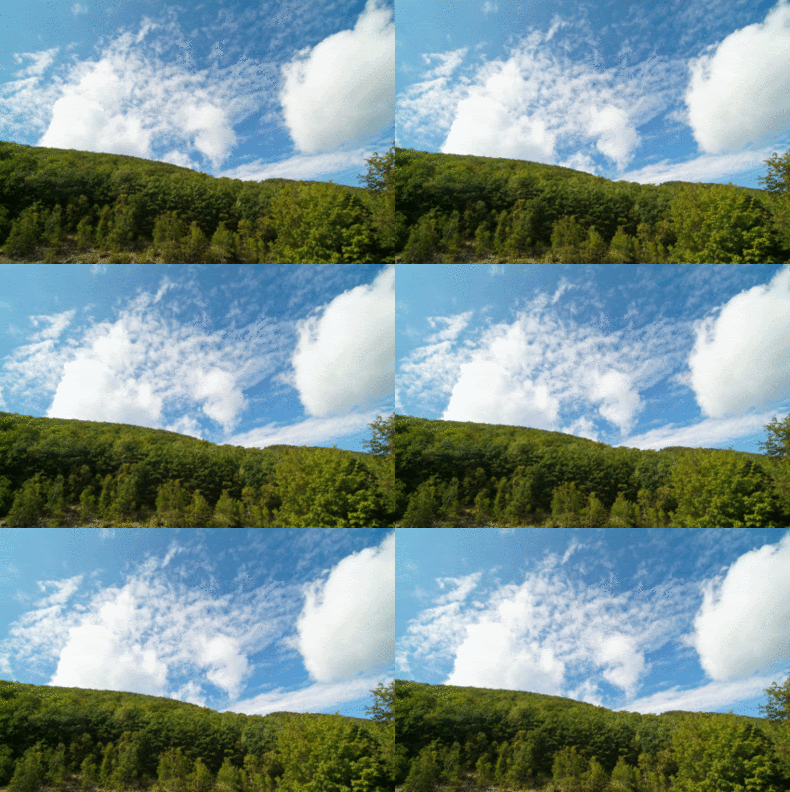 The clouds coming over the mountains were blowing my mind.
NOTE TO ALI: If we're going to do a series of these, you gotta get that sensor cleaned. I can colour-adjust everything at once, but all those spots have to be cleaned up one by one on every single frame!
 I don't know why the really nice light in this picture gets lost once it's uploaded to Blogger.
 A cute motel in Pleasant Bay, inexplicably painted to resemble a pro-life sign
 View from the second night's inn in Chéticamp
 The infamous Skyline Trail. Yikes!
 Sure was windy.
Thursday, September 08, 2011
Long Weekend on the Trail
I should have mentioned after dropping that bomb on you in the last post that Alison and I would be in Cape Breton last weekend. I basically begged for feedback on my big news and then ran out the door for three days — sorry.
Anyway, we drove around the Cabot Trail, getting out many times along the way to take pictures, and even going on a couple of short hikes. It was beautiful. Unfortunately, you'll have to take my word for it, because Ali has all the photos and is now in another apartment without internet. Bah!
Maybe you can just pretend these are ours:
 We saw a moose on the first trail we hiked along — REALLY close up! I'd only ever seen a dead one before.
 This trail — the Skyline — was spectacular. It ends on a really high, really narrow ridge overlooking a deep valley, the ocean, and the Cabot Trail itself, far below. It's also the trail that that girl got killed by a coyote on, in case the view is not fear-inducing enough.
Anyway, we drove around the Cabot Trail, getting out many times along the way to take pictures, and even going on a couple of short hikes. It was beautiful. Unfortunately, you'll have to take my word for it, because Ali has all the photos and is now in another apartment without internet. Bah!
Maybe you can just pretend these are ours:
 We saw a moose on the first trail we hiked along — REALLY close up! I'd only ever seen a dead one before.
 This trail — the Skyline — was spectacular. It ends on a really high, really narrow ridge overlooking a deep valley, the ocean, and the Cabot Trail itself, far below. It's also the trail that that girl got killed by a coyote on, in case the view is not fear-inducing enough.
Saturday, September 03, 2011
Big News
So, you may or may not know this, but Alison's and my relationship has taken some interesting turns in the past year or so. I haven't talked about them on here, because people don't generally want to hear about the private lives of couples. Or rather, they don't want to hear about couples they know, directly from the horse's mouth, as it were. Gossip is another story entirely...
But it's gotten to the point where not talking about it is going to cause confusion among the people we love, as well as make us feel inauthentic or even dishonest with respect to them. So here's the basic story, leaving out the gory details as much as possible.
The big change that happened is that we started seeing other people, romantically, almost a year ago. It was a mutual decision, made for personal, psycho-philosophical/spiritual reasons. Essentially, neither one of us had ever seen monogamy as an important value, and we both realized we'd only lived monogamously up until then because it's the cultural norm.
So we talked a lot about it and read books and internet articles about how to develop and maintain loving relationships with more than one person in an ethical way, where everyone gets to be happy and no one gets hurt. It's called "polyamory," and you can find out LOTS about it just by Googling that word. The main ideas are lots of honest communication, empathy, and willingness to examine one's own fears and motives. The same kinds of qualities that are important in monogamous relationships, really, except that here it becomes apparent much faster when any of those qualities is lacking.
Then we went out to find other people who would be interested in being part of this social experiment with us. Alison met a few different guys, none of whom turned out to be all that interested in either the "honest communication" aspect of the project or its intent to expand the boundaries of real, genuine love. That was hard for her, but it also taught her something about knowing exactly what you want.
I, on the other hand, met a really nice woman named Amber who, if anything, is even more interested in breaking down cultural barriers with love and compassion than we had originally been. That was in October, and we're still together. I'll introduce you to her, if you're interested.
Does this sound like the craziest kind of lifestyle choice you've ever heard of? Are you thinking we must be some kind of masochists to want to put ourselves through this? It is definitely hard work, I'll grant you that. But there are a lot of people out there trying to make it work (more than you'd guess), many of them quite successfully. And, as they're all the type of people interested in honest and open communication, they have lots of good advice and stories on which to draw. I've probably gotten way more helpful and concrete guidance on how to do non-monogamy right than I've ever found about how to do monogamy right.
I'm not going to say everything's perfect now and we've got this all figured out, because it's not, and we haven't. We have definitely made mistakes. People's feelings have been hurt. Mostly, I'd say, fear has been the biggest problem, and lack of honesty because of it. For instance, I've been scared to tell people about whom I care deeply what's been going on, for fear that they would think badly of me, even knowing that I could be causing them suffering by letting them gather incomplete information on their own. And Amber has been hurt by my inauthenticity about our relationship, because it feels like I perceive the relationship itself as inauthentic.
Alison, meanwhile, has been experiencing fears of her own — that my new relationship will replace ours, that she'll never get over feeling jealous, and that this whole thing may have been a big mistake because she may really be a monogamous person at heart. I sympathize with all these fears, but I also have really good reasons for believing that they'll eventually prove unfounded. However, I don't seem to be the best person to prove them unfounded to her, at least not at this time. We saw a couples' counsellor for a little while, and she recommended that Alison find some ways to become more independent, in order to observe her own fears more objectively.
So, the latest interesting turn is that, starting next week, Alison will be temporarily moving into the spare room of a generous friend of ours for one month, while I stay in our apartment. The idea is that she will have a better idea of what she wants, given some alone time where she's forced to be more self-sufficient. I'm sure living alone will also produce some new insights in me. We'll see what happens after that, but I'm very hopeful, because we are both committed to maintaining a relationship full of love and honesty and generosity, whatever form that takes.
I'm sorry to hit you with such a potentially shocking bit of news and then end the story on a note of uncertainty. But I hope you get that a) we are both still mostly happy and positive about the future, and b) I'm telling you about all of this because I love you and want you to understand my life choices, even though you might not agree with them. I realize this is a weird bunch of information to digest, but I hope you won't be shy about asking me any questions you might have about it. And if you'd rather not talk about it, that's fine too.
Love,
Andrew.
But it's gotten to the point where not talking about it is going to cause confusion among the people we love, as well as make us feel inauthentic or even dishonest with respect to them. So here's the basic story, leaving out the gory details as much as possible.
The big change that happened is that we started seeing other people, romantically, almost a year ago. It was a mutual decision, made for personal, psycho-philosophical/spiritual reasons. Essentially, neither one of us had ever seen monogamy as an important value, and we both realized we'd only lived monogamously up until then because it's the cultural norm.
So we talked a lot about it and read books and internet articles about how to develop and maintain loving relationships with more than one person in an ethical way, where everyone gets to be happy and no one gets hurt. It's called "polyamory," and you can find out LOTS about it just by Googling that word. The main ideas are lots of honest communication, empathy, and willingness to examine one's own fears and motives. The same kinds of qualities that are important in monogamous relationships, really, except that here it becomes apparent much faster when any of those qualities is lacking.
Then we went out to find other people who would be interested in being part of this social experiment with us. Alison met a few different guys, none of whom turned out to be all that interested in either the "honest communication" aspect of the project or its intent to expand the boundaries of real, genuine love. That was hard for her, but it also taught her something about knowing exactly what you want.
I, on the other hand, met a really nice woman named Amber who, if anything, is even more interested in breaking down cultural barriers with love and compassion than we had originally been. That was in October, and we're still together. I'll introduce you to her, if you're interested.
Does this sound like the craziest kind of lifestyle choice you've ever heard of? Are you thinking we must be some kind of masochists to want to put ourselves through this? It is definitely hard work, I'll grant you that. But there are a lot of people out there trying to make it work (more than you'd guess), many of them quite successfully. And, as they're all the type of people interested in honest and open communication, they have lots of good advice and stories on which to draw. I've probably gotten way more helpful and concrete guidance on how to do non-monogamy right than I've ever found about how to do monogamy right.
I'm not going to say everything's perfect now and we've got this all figured out, because it's not, and we haven't. We have definitely made mistakes. People's feelings have been hurt. Mostly, I'd say, fear has been the biggest problem, and lack of honesty because of it. For instance, I've been scared to tell people about whom I care deeply what's been going on, for fear that they would think badly of me, even knowing that I could be causing them suffering by letting them gather incomplete information on their own. And Amber has been hurt by my inauthenticity about our relationship, because it feels like I perceive the relationship itself as inauthentic.
Alison, meanwhile, has been experiencing fears of her own — that my new relationship will replace ours, that she'll never get over feeling jealous, and that this whole thing may have been a big mistake because she may really be a monogamous person at heart. I sympathize with all these fears, but I also have really good reasons for believing that they'll eventually prove unfounded. However, I don't seem to be the best person to prove them unfounded to her, at least not at this time. We saw a couples' counsellor for a little while, and she recommended that Alison find some ways to become more independent, in order to observe her own fears more objectively.
So, the latest interesting turn is that, starting next week, Alison will be temporarily moving into the spare room of a generous friend of ours for one month, while I stay in our apartment. The idea is that she will have a better idea of what she wants, given some alone time where she's forced to be more self-sufficient. I'm sure living alone will also produce some new insights in me. We'll see what happens after that, but I'm very hopeful, because we are both committed to maintaining a relationship full of love and honesty and generosity, whatever form that takes.
I'm sorry to hit you with such a potentially shocking bit of news and then end the story on a note of uncertainty. But I hope you get that a) we are both still mostly happy and positive about the future, and b) I'm telling you about all of this because I love you and want you to understand my life choices, even though you might not agree with them. I realize this is a weird bunch of information to digest, but I hope you won't be shy about asking me any questions you might have about it. And if you'd rather not talk about it, that's fine too.
Love,
Andrew.
Subscribe to:
Posts (Atom)